
Offshore vs US Sportsbooks Comparison
The US sports betting landscape has changed more in the last seven years than in the previous century. Before 2018, legal sports betting barely existed outside Nevada. After the Supreme Court’s decision to strike down the federal prohibition, states began legalizing one by one, and today more than 30 states have active legal markets. Names like DraftKings, FanDuel, and BetMGM are now household brands with television ads and stadium naming rights.
But offshore sportsbooks — platforms like Bovada, BetOnline, and MyBookie, licensed in jurisdictions like Curaçao and Costa Rica — have been serving US customers for decades and never stopped. They operate in a legal gray area under US law, and they remain popular for reasons that go well beyond simply filling a gap in states without legal betting.
This article gives you a clear, honest comparison of both options so you can make an informed decision based on your situation, your priorities, and how you like to bet.
For reviews of both onshore and offshore sports betting sites see our XSportsbook/Reviews
What Is an Offshore Sportsbook?
An offshore sportsbook is a betting platform that holds a gaming license from an international regulatory body — commonly in Curaçao, Antigua and Barbuda, or Costa Rica — and accepts customers from the United States.
These books operate legally under the laws of their home jurisdiction. US federal law does not explicitly criminalize the act of placing a bet at an offshore sportsbook, and no US bettor has ever been prosecuted for doing so. The legal exposure, such as it exists, sits with the operators rather than the customers. The established books — Bovada, BetOnline, MyBookie, BetUS, Bookmaker.eu, and a handful of others — have operated for 15 to 30 years without customer funds being seized or accounts being frozen.
It is not a perfectly clean legal situation, and it is worth being honest about that. But the practical reality for bettors, based on a long track record, is that the risks are minimal when you use reputable, established platforms.
What Is a Legal US Sportsbook?
A legal US sportsbook is licensed and regulated by a state gambling authority in a state that has passed sports betting legislation. These books go through rigorous vetting processes, maintain consumer protection standards, and operate under ongoing oversight.
The major players in this space are DraftKings, FanDuel, BetMGM, Caesars Sportsbook, and PointsBet, among others. They are available as apps on iOS and Android, are integrated with banking systems that allow direct ACH deposits and withdrawals, and report gambling activity to tax authorities.
Legal sportsbooks are only accessible to residents physically located within a state that has legalized betting. Geolocation technology is used to verify your location every time you place a bet. If you live in a legal state, you can access these books without any of the ambiguity that comes with offshore platforms.
A Side-by-Side Comparison
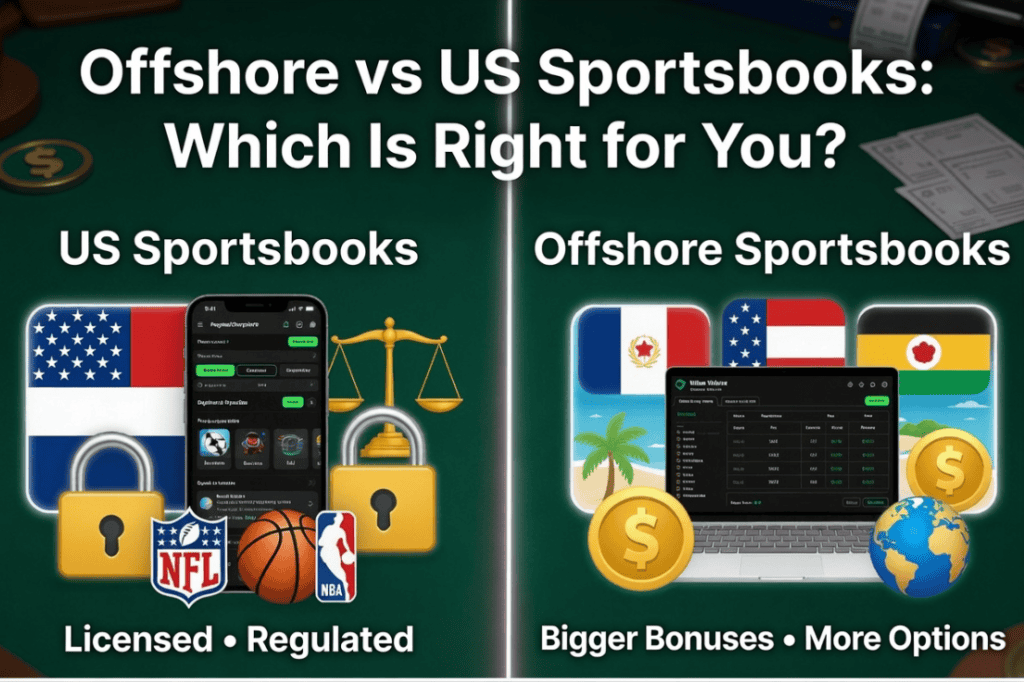
The right choice depends on which factors matter most to you. Here is how the two categories compare across the dimensions that matter most to bettors.
Availability
Legal US sportsbooks are available in states where sports betting has been legalized — currently more than 30, with more expected over the next few years. They are not available to bettors in states without legislation, regardless of proximity to a legal state’s border.
Offshore sportsbooks are available to US residents in nearly every state, including those where local betting options do not yet exist. For bettors in states like Texas, California, or Florida — large markets where legislation has stalled — offshore books are effectively the only option.
Bonuses and Promotions
This is one of the most significant practical differences between the two options. Offshore books offer substantially larger welcome bonuses than their US-regulated counterparts. Deposit match bonuses of 50% to 200% are common at platforms like BetUS and BetOnline, with initial offers frequently running into hundreds of dollars.
Legal US sportsbooks face different regulatory environments — some states cap what books can offer in promotions, and the highly competitive legal market has compressed margins. Welcome offers from DraftKings, FanDuel, and BetMGM do exist and can be valuable, but they are generally structured as first-bet offers or bonus credit amounts rather than the larger match bonuses seen offshore.
The trade-off is rollover. Offshore bonuses come with wagering requirements that must be cleared before you can withdraw. Legal US books sometimes offer cleaner bonus structures, though their headline numbers are usually smaller.
Odds and Lines
Legal US books typically offer competitive odds on major US sports markets — NFL, NBA, MLB, and NHL. However, their margin (the vig built into the lines) is often higher than what you will find at offshore books, particularly at platforms like Bookmaker.eu that are known for sharp, low-juice pricing.
Experienced bettors who track their results closely often find that the difference in juice — even a fraction of a percentage point on every bet — compounds meaningfully over a full season. The offshore books that cater to sharp bettors offer tighter lines, which matters most to high-volume players.
For casual bettors placing a few bets per week, the difference in line quality is less impactful than other factors like interface, accessibility, and bonus value.
Crypto Banking
This is an area where offshore books have a substantial and growing advantage. All of the major offshore platforms accept Bitcoin, Ethereum, Litecoin, and other cryptocurrencies for deposits and withdrawals. Crypto transactions are typically processed within minutes to a few hours, with no fees and no bank intervention.
Legal US sportsbooks generally do not accept cryptocurrency. They rely on ACH transfers, online banking, debit cards, and PayPal. ACH withdrawals can take 3 to 5 business days, and some transactions are flagged or declined by banks that flag gambling activity.
For bettors who use crypto, or who have experienced banking friction with legal books, this difference is significant.
Compare Crypto Welcome Bonuses
 BetUS BetUS |  Bovada Bovada |  MyBookie MyBookie | |
|---|---|---|---|
| Rating | |||
| Welcome Bonus | Crypto 200% to $2,750
FIRST200 | Crypto 150% To $750
BTCSWB750 | Crypto 100% to $1,000
CRYPTO100 |
| See BonusRead Review | See BonusRead Review | See BonusRead Review |
Withdrawal Speed
Offshore books with crypto banking offer the fastest withdrawals in the industry. Bitcoin payouts from Bovada, BetOnline, or MyBookie are typically processed within 24 to 48 hours for verified accounts, often faster.
Traditional banking methods at offshore books — checks by courier, wire transfers — are slower and less convenient. This was historically a friction point with offshore platforms, but the rise of crypto banking has largely resolved it for bettors willing to use digital currency.
Legal US books vary by platform and state. PayPal withdrawals at DraftKings can be fast. ACH transfers may take several business days. In some cases, legal books have been criticized for slow processing times despite their regulatory standing.
Betting Limits
Offshore books tend to offer higher limits than regulated US platforms, particularly for recreational bettors making standard market bets. Sharp bettors who win consistently may find their limits reduced at both types of platforms, but this happens more aggressively at legal US books where automated risk systems are calibrated differently.
Bookmaker.eu is particularly well regarded for maintaining high limits and welcoming winning players — a reputation built over more than two decades. BetOnline also offers competitive limits on major market bets.
Best for Large Wagers
 Bookmaker.eu Bookmaker.eu | BetUS |  BetOnline BetOnline | |
|---|---|---|---|
| Rating | |||
| Welcome Bonus | 100% Up To $400
GET100 | 125% Up To $2,625
JOIN125 | 50% To $250
FREE250 |
| See BonusRead Review | See BonusRead Review | See BonusRead Review |
Product Depth
Offshore books typically offer sports betting, casino games, poker, and racebook under one roof. A single account covers the full range of gambling products. This is a convenience factor that legal US books cannot always match, as the licensing structure in many states separates sportsbook, casino, and poker operations.
For bettors who mix sports wagering with occasional casino play or poker sessions, the offshore all-in-one model is genuinely more convenient.
Consumer Protections
Legal US sportsbooks operate under state gambling authority oversight. If there is a dispute about a payout, you have a clear regulatory body to escalate to. Funds held by legal books are protected under state regulations, and the books are subject to periodic audits.
Offshore books have no comparable regulatory backstop for US customers. If a dispute arises, your recourse is limited to the book’s customer service team and, ultimately, public reputation and review forums. This is the clearest structural advantage legal books hold.
The practical risk for bettors using established offshore platforms is low — Bovada has paid customers reliably for over 20 years, and BetOnline and Bookmaker.eu have comparable track records. But the absence of a regulatory safety net is a real difference, not a theoretical one.
Tax Reporting
Legal US sportsbooks are required to report significant gambling winnings to the IRS using W-2G forms. Offshore books do not file US tax reports. However, US gamblers are legally obligated to report and pay taxes on all gambling winnings regardless of where the bet was placed. The difference is in enforcement and reporting, not in your legal obligations.
Which Type of Bettor Benefits Most From Each Option
Consider a US sportsbook if:
You live in a state with a legal market and want the simplicity of a licensed, regulated product. You prefer direct bank account integration without dealing with crypto. You value the peace of mind that comes with regulatory oversight. You are a casual bettor who places a modest number of bets per week and does not need large bonuses or sharp lines to make the experience worthwhile.
Consider an offshore sportsbook if:
You live in a state where legal betting is not yet available. You want to take advantage of larger welcome bonuses and ongoing promotions. You use cryptocurrency and want fast, fee-free withdrawals. You are a higher-volume bettor who cares about line quality and betting limits. You want access to casino, poker, and racebook alongside your sports wagering in one account.
Consider using both if:
You live in a legal betting state and want to get the best of both worlds. Many experienced bettors maintain accounts at one or two legal US books alongside one or two offshore platforms and shop lines before each bet. This approach captures the regulatory security of a licensed book while retaining access to the better bonuses and sharper odds offshore.
The Best Established Offshore Sportsbooks
For bettors who decide that offshore is the right fit, the following platforms have the longest track records of reliable payouts and fair treatment of US customers.
Bovada has been the most popular offshore book for US customers for years, known for its clean interface, strong live betting product, and consistent payouts. It is particularly well suited for beginners and casual bettors.
BetOnline appeals to more experienced bettors with its sharp lines, deep market coverage, and strong crypto banking infrastructure. It has operated for over 20 years and has a solid reputation for honoring payouts.
Bookmaker.eu is the choice for serious bettors who prioritize line quality and high limits. It offers among the most competitive odds in the offshore market and maintains a reputation for welcoming sharp action.
BetUS stands out for its generous bonus structure and extensive promotional activity. It covers major US and international sports thoroughly and appeals to bettors who want a high-energy, promotion-forward experience.
MyBookie is popular for its prop bet offerings and flexible promotions. It strikes a balance between being accessible for new bettors and offering enough depth for more experienced players.
FAQ
- Is it illegal to bet at an offshore sportsbook in the US?
- Do offshore books pay out reliably?
- Can I use both a legal US book and an offshore book?
- Will my bank block deposits to offshore sportsbooks?
- How do I know if an offshore sportsbook is trustworthy?
The Bottom Line
Neither offshore nor legal US sportsbooks are universally better. They serve different needs and come with different trade-offs. The best choice depends on where you live, how you fund your account, how much you bet, and how much regulatory security matters to you.
What is clear is that bettors today have more options than at any point in history. Whether you place your bets on a state-licensed app or an offshore platform with a 20-year track record, the key is choosing a reputable book, understanding the terms, and approaching the experience with the same discipline you would apply to any financial decision.
For detailed reviews of both offshore and US-based sportsbooks, visit XSportsbook/Reviews
